Quartz vs. Quartzite Countertops: Which Is Better?

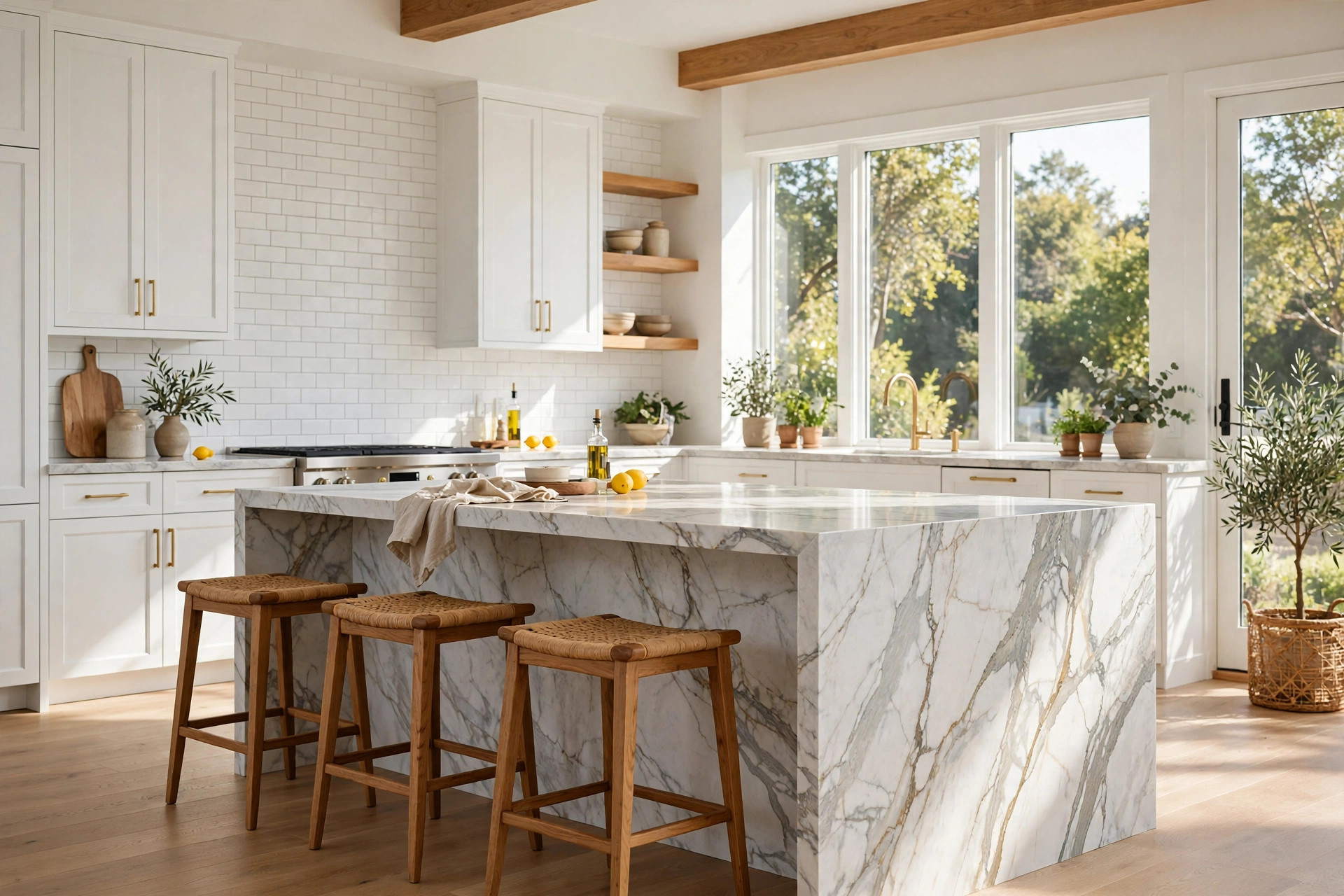
Quartz and quartzite can create similar high-end kitchen looks, but they are very different countertop materials. Quartz is an engineered surface designed for consistency and relatively simple maintenance. Quartzite is natural stone, so every slab has its own color, movement, and care requirements.
For Chula Vista homeowners planning a kitchen remodel, the better choice usually comes down to daily habits. Cooking frequency, spills, maintenance tolerance, island size, direct sunlight, and how much natural variation you want can matter more than which material looks better in a showroom.
Quartz is usually the better fit for homeowners who want lower maintenance, consistent patterns, and no routine sealing. Quartzite is often the better fit for homeowners who prefer natural stone, distinctive veining, and stronger natural heat tolerance and who are comfortable with stone-specific care.
Quartz vs. Quartzite at a Glance
| Factor | Quartz | Quartzite |
|---|---|---|
| Material | Engineered surface | Natural stone |
| Appearance | More predictable | Unique slab variation |
| Sealing | Generally not required | May be recommended for the specific stone |
| Heat | Use trivets and heat protection | Better natural heat tolerance; protection still recommended |
| Stain resistance | Generally strong | Depends on stone, finish, sealing, and cleanup |
| Maintenance | Relatively simple | More stone-specific |
| Pattern consistency | Higher | Lower |
| Slab selection | Product sample is often useful | Actual slab should be reviewed |
| Strong fit for | Low-maintenance households | Homeowners prioritizing natural stone |
The material category is only the starting point. The specific quartz product or quartzite slab still needs to be evaluated before fabrication.
What Is the Difference Between Quartz and Quartzite?
Quartz
Quartz countertops are engineered surfaces made with mineral material combined with resins, pigments, and other components.
Manufacturing allows producers to create more predictable colors and patterns. A homeowner selecting a white marble-look quartz, for example, generally has more control over the final appearance than someone choosing a naturally veined stone slab.
Quartzite
Quartzite is natural stone quarried and fabricated into slabs.
Its color, veining, movement, and natural characteristics vary. Two slabs sold under the same material name may not look identical.
The simplest distinction is:
Quartz provides more design predictability. Quartzite provides more natural variation.
Start With How Your Household Uses the Kitchen
Countertops look pristine when samples are sitting in a showroom. Daily kitchens are different.
Think about what happens on your countertops during a normal week:
- Frequent cooking and meal prep
- Children making snacks
- Coffee, wine, oils, and sauces
- Hot pans moving between the range and island
- Guests gathering around the counter
- Cleaning at the end of a busy day
- Little or no interest in periodic stone maintenance
A homeowner who wants a surface that requires less attention may lean toward quartz.
Someone who values natural stone enough to accept more slab-specific care may prefer quartzite.
Quartz vs. Quartzite Maintenance
Maintenance is one of the clearest differences between the two materials.
Quartz Maintenance
Quartz generally does not require routine sealing.
Daily care is usually straightforward: wipe spills promptly and use cleaners permitted by the countertop manufacturer. Abrasive products, harsh chemicals, and excessive heat should be avoided unless the product’s care instructions specifically allow them.
This simplicity makes quartz appealing in kitchens where minimizing maintenance is a major priority.
Quartzite Maintenance
Quartzite needs a more material-specific approach.
Some slabs may benefit from an appropriate impregnating sealer. The purpose of sealing is to improve resistance to absorption and staining; it does not make natural stone completely stain-proof.
The exact care plan can depend on the stone, finish, and installation.
Don’t Follow a Generic Resealing Schedule
Avoid choosing quartzite based on a blanket rule such as “seal it every year.”
Before fabrication, ask the supplier or fabricator:
- Does this specific material need sealing?
- Which sealer is recommended?
- How should you determine when another application is needed?
- Which cleaners are compatible with the stone?
- Are there substances or cleaning products that should be avoided?
The maintenance plan should match the actual slab.
What Happens When Something Spills?
Kitchen countertops encounter much more than water.
| Kitchen Situation | Quartz | Quartzite |
|---|---|---|
| Coffee or wine | Clean promptly | Clean promptly |
| Cooking oil | Generally low absorption | Actual stone porosity matters |
| Sink splashes | Routine cleanup | Stone characteristics may affect absorption |
| Daily cleaner | Follow manufacturer guidance | Use stone-compatible products |
| Sealing | Generally not required | May be recommended |
Quartz is often appealing to households with high spill anxiety because its engineered surface is relatively easy to maintain.
Quartzite can perform very well too, but the exact stone matters more.
Stain resistant does not mean stain proof. Prompt cleanup is good practice with either material.
Heat Resistance: Which Handles Heavy Cooking Better?
Quartzite has an advantage when natural heat tolerance is a major concern, but countertop care should not become a contest to see which material can survive a hot pan.
Quartz and Heat
Engineered quartz contains resins that can be affected by concentrated or sustained heat.
Use:
- Trivets
- Heat pads
- Protective boards
Avoid routinely placing cookware straight from the range or oven onto the countertop.
Quartzite and Heat
Natural quartzite generally tolerates heat better than engineered quartz.
That does not make direct hot-pan placement a good daily habit. Trivets still reduce unnecessary thermal stress and protect the finished surface.
A household that already uses heat protection consistently may find quartz perfectly practical. In a heavily used cooking kitchen, quartzite’s natural-stone heat characteristics may carry more weight in the decision.
With Quartzite, Approve the Actual Slab
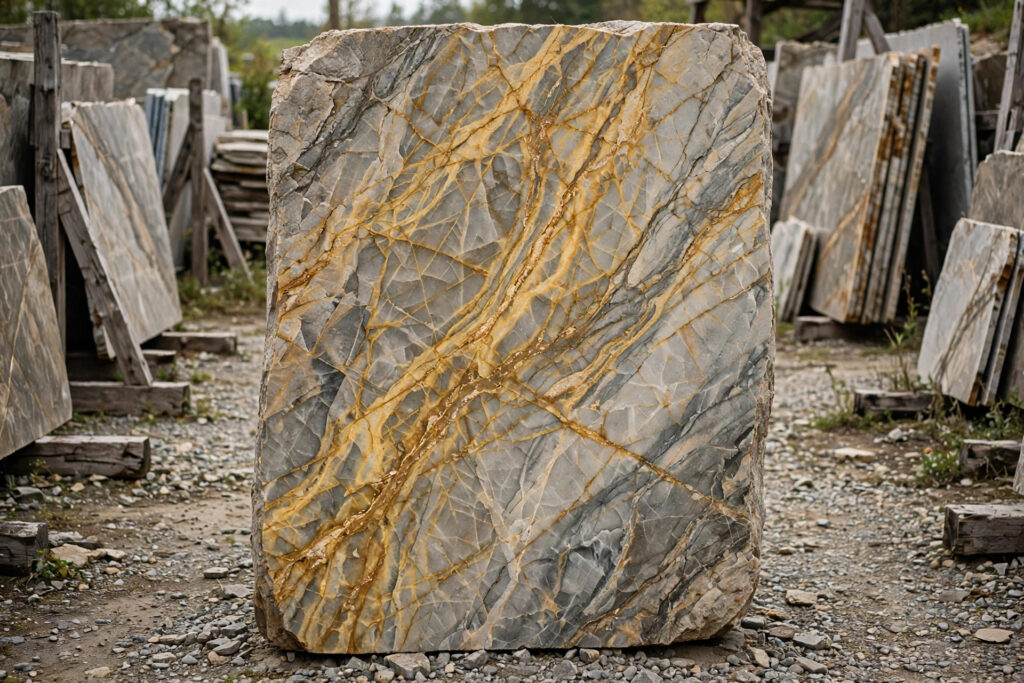
Quartzite should not be selected only from a small sample.
Large slabs can contain substantial changes in:
- Vein direction
- Color
- Movement
- Light and dark areas
- Natural features
- Pattern density
This becomes especially important when the stone will cover a large kitchen island.
Plan Where the Stone Will Go
Before fabrication, review how the slab will be allocated across:
- Main countertop runs
- Island surface
- Waterfall panels
- Backsplash sections
A dramatic section of veining may look best centered on the island rather than disappearing around a sink cutout.
Review Seam Placement
Long countertop runs or large islands may require multiple pieces.
Discuss seam locations and pattern direction before fabrication rather than discovering them during installation.
Confirm What Quartzite You Are Buying
Stone trade names can sometimes create confusion because similarly named materials may have different physical characteristics.
For a quartzite selection, ask the supplier or fabricator for clarity on:
- Exact material name
- Material classification
- Care instructions
- Sealing recommendations
- Known sensitivities
- Fabrication considerations
That information is more valuable than assuming every surface carrying the quartzite label behaves exactly the same way.
Appearance: Predictability vs. Natural Variation
Quartz and quartzite can both create striking kitchens. The visual decision is really about control.
Quartz Gives You More Predictability
Quartz may make sense when you want:
- Consistent color
- Predictable veining
- Easy coordination with cabinets
- Similar appearance across multiple countertop sections
This can be useful when the countertop should support the design rather than dominate it.
Quartzite Gives You Natural Movement
Quartzite may make sense when you want:
- Natural veining
- Variation from slab to slab
- A one-of-a-kind surface
- A dramatic island focal point
The slab itself becomes part of the design process.
Large Kitchen Islands Change the Decision
A large island exposes much more countertop surface, so material characteristics become more noticeable.
Quartz on a Large Island
Quartz can make pattern planning more predictable, especially when the goal is visual consistency between perimeter countertops and the island.
Quartzite on a Large Island
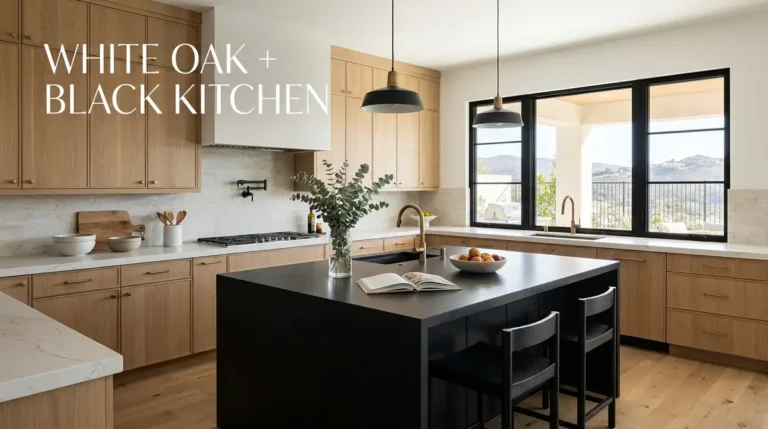
Quartzite can turn an island into a natural-stone focal point.
It also makes slab planning more important. Confirm:
- Whether one slab can cover the intended area
- Where seams may be required
- How veining will run
- How many slabs are needed
- Which part of the slab will appear on the island
If your remodel includes a substantial island or new cabinetry, Vexkitch’s modern countertop options for kitchens can be planned together rather than treating the countertop as a last-minute finish.
Waterfall Edges Need Early Planning
A waterfall island extends countertop material vertically down one or both ends.
With quartzite, vein direction and slab allocation can have a major effect on the finished appearance.
A useful planning sequence is:
Choose slab → map island top → map waterfall panel → review vein direction → confirm slab quantity
Quartz can provide more predictable pattern control, although fabrication details still need to be planned before cutting.
Full-Height Backsplash Considerations
Running the countertop material up the wall creates another reason to think beyond square footage.
Quartz may offer more predictable visual repetition.
Quartzite can create dramatic natural movement, but the project may require:
- Additional slab material
- Vein matching
- Careful cut placement
- Outlet and switch cutouts
- Seam planning
Ask one design question early:
Should the countertop quietly support the cabinets, or should the stone become one of the kitchen’s main visual features?
Direct Sunlight and Bright Kitchens
Strong, prolonged direct sunlight should be considered when selecting engineered quartz.
Specific quartz products can have different recommendations regarding UV exposure, so check the manufacturer’s installation guidance for counters near large windows or strong afternoon sun.
Natural quartzite does not contain the same resin system as engineered quartz, but the actual stone and finish should still be evaluated for the intended installation.
This can be especially relevant in bright South Bay kitchens with large glazed openings or strong indoor-outdoor connections.
Quartz vs. Quartzite Cost: Compare the Installed Scope
Material price alone does not tell you what the finished countertop project will cost.
A countertop quote may include:
- Number of slabs
- Material yield
- Fabrication
- Sink cutouts
- Edge profile
- Seam work
- Backsplash
- Waterfall panels
- Existing-counter removal
- Difficult access
| Quote Item | Quartz | Quartzite |
|---|---|---|
| Material/slabs | Confirm | Confirm |
| Number of slabs | Confirm | Confirm |
| Fabrication | Included? | Included? |
| Sink cutout | Included? | Included? |
| Edge profile | Included? | Included? |
| Seam planning | Confirm | Confirm |
| Waterfall panels | Included? | Included? |
| Backsplash | Included? | Included? |
| Removal/disposal | Included? | Included? |
| Sealing | Usually not applicable | Confirm if required |
Homeowners comparing the countertop as part of a larger project should focus on estimating the kitchen renovation budget rather than choosing from material price alone.
Confirm Availability Before Countertop Installation
Countertop planning should happen before the remodel reaches the point where fabrication is holding up the rest of the kitchen.
For quartzite, confirm:
- The selected slab is reserved
- Enough material is available
- Additional matching slabs are available if needed
- Fabrication timing is understood
For quartz, verify:
- Color and pattern availability
- Quantity needed
- Product lead time
This becomes more important with large islands, waterfall ends, and full-height backsplashes.
The Vexkitch Quartz vs. Quartzite Decision Scorecard
| Factor | Lean Quartz | Lean Quartzite |
|---|---|---|
| Low-maintenance priority | Strong fit | More care may be required |
| Predictable pattern | Strong fit | Natural variation |
| Natural stone priority | Less important | Strong fit |
| Heavy cooking | Use heat protection | Stronger case |
| Spill anxiety | Strong fit | Stone-specific |
| Large statement island | Controlled look | Natural focal point |
| Full-height backsplash | Predictable pattern | Unique movement |
| Interest in slab selection | Less critical | Important |
| Stone-specific maintenance | Not desired | Acceptable |
Quartz Is Likely the Better Fit When
You want simple maintenance, predictable appearance, no routine sealing, and less variation between samples and the finished surface.
Quartzite Is Likely the Better Fit When
Natural stone is a priority, unique slab movement matters, you are comfortable with material-specific maintenance, and choosing the exact slab is part of the design process.
Which Is Better for a Busy Family Kitchen?
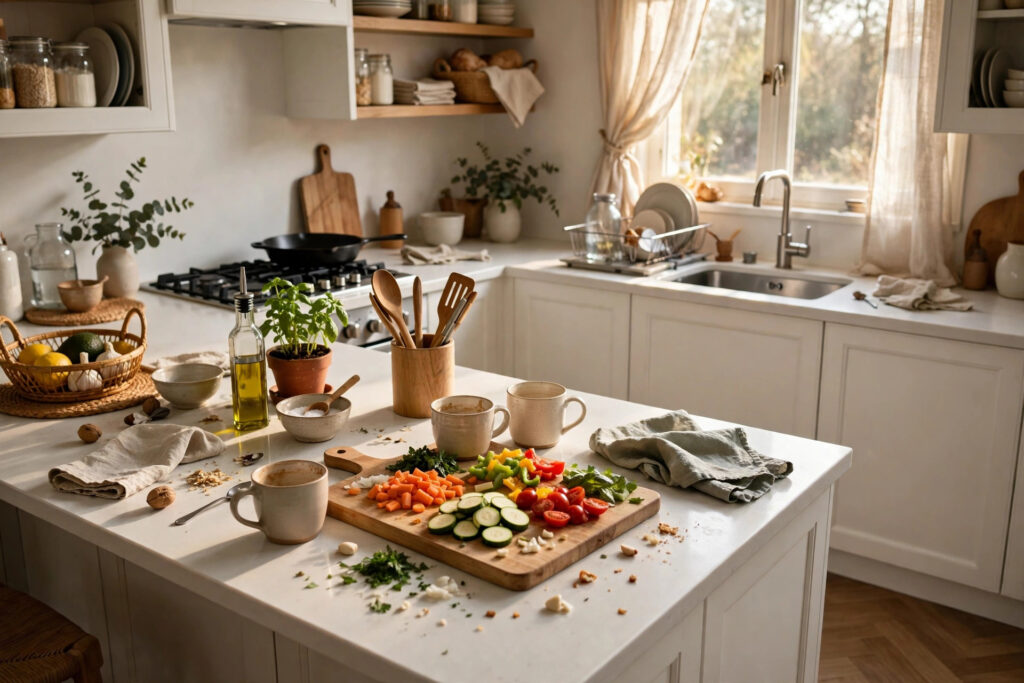
Quartz is often the easier fit for a busy household that wants low-maintenance counters and predictable performance around everyday spills.
Quartzite can still work very well in an active family kitchen, especially when natural stone and heat tolerance are higher priorities. The homeowner should be comfortable following the care recommendations for the selected slab.
The right answer depends more on maintenance expectations than family size alone.
Which Is Better for a Chula Vista Kitchen Remodel?
Countertop material should be considered alongside the rest of the kitchen rather than chosen in isolation.
Think about:
- Cabinet colors
- Island size
- Sink configuration
- Backsplash
- Natural light
- Cooking habits
- Maintenance tolerance
- Overall remodel budget
A remodel with a large statement island may lead to a different countertop decision than a compact kitchen where the goal is low-maintenance everyday functionality.
For projects involving cabinetry, surfaces, layout, and other coordinated upgrades, complete kitchen remodeling services in Chula Vista provide the broader planning context.
Free Download
Quartz vs. Quartzite Countertop Decision Checklist — a one-page printable covering usage, maintenance, slab checks, layout planning, and quote comparison from this article, with checkboxes you can bring to a design consultation.
Download the Quartz vs. Quartzite Decision Checklist (PDF)
Frequently Asked Questions
Is quartz or quartzite better for kitchen countertops?
Quartz is often better for homeowners who prioritize low maintenance and predictable patterns. Quartzite is often better for homeowners who prioritize natural stone, unique slab variation, and stronger natural heat tolerance.
Does quartzite stain easily?
Stain resistance varies according to the actual stone, finish, porosity, sealing, and cleanup habits. Spills should be cleaned promptly even when the stone has been sealed.
Does quartzite need to be sealed?
Some quartzite may benefit from sealing, while care requirements can vary between stones. Follow the recommendations for the actual slab rather than applying one universal resealing schedule.
Can you put hot pans on quartz?
Using trivets or heat pads is recommended. Engineered quartz contains resins that can be affected by prolonged or concentrated heat.
Can you put hot pans on quartzite?
Quartzite generally has better natural heat tolerance than engineered quartz, but trivets are still a sensible way to protect the finished countertop.
Is quartzite harder to maintain than quartz?
It can require more material-specific care because the stone may need sealing and compatible cleaning products. Quartz generally requires simpler routine maintenance.
Does quartzite cost more than quartz?
Either material can vary widely in price. Compare the full installed scope, including slab quantity, fabrication, seams, edge work, backsplash, waterfall panels, cutouts, and removal.
Is quartzite better for a large kitchen island?
Quartzite can make a large island a strong natural focal point. Slab size, vein direction, seam placement, and material quantity need to be planned before fabrication.
Does quartz fade in sunlight?
Some engineered quartz products may be affected by prolonged UV exposure. Check the specific manufacturer’s guidance when the countertop will receive strong direct sunlight.
Planning New Countertops in Chula Vista?
Quartz offers predictable design and relatively simple maintenance. Quartzite offers natural variation and a more slab-specific design and care experience. The better material is the one whose trade-offs fit how the kitchen will actually be used.
Vexkitch Kitchen Remodeling has served remodeling clients since 2017 and has completed 700+ projects with four full-time crews. Homeowners planning new counters can review our countertop installation services or explore complete kitchen remodeling services in Chula Vista when countertops are part of a larger renovation.
Contact Vexkitch Kitchen Remodeling to discuss your kitchen project.