Kitchen Flooring Options: Tile, Hardwood & LVP Compared

Kitchen flooring takes more punishment than any other floor in the house. Spilled pasta water, a dropped cast-iron pan, muddy paws from the backyard, a chair dragged across the same spot every morning — the kitchen floor absorbs all of it. Homeowners planning a kitchen remodel in Chula Vista often choose cabinets and countertops first, then pick flooring to match. The floor deserves the same attention. It covers the largest surface in the room, it sets the tone for the whole design, and replacing it later means moving every appliance and cabinet.
This comparison covers the five kitchen flooring options most Chula Vista homeowners actually choose: porcelain and ceramic tile, hardwood and engineered wood, luxury vinyl plank, laminate, and natural stone. Each one is judged the same way — how it handles water, how it holds up to daily wear, what it costs to install, and where it fits in a South Bay home.
What Makes Kitchen Flooring Different
A living room floor deals with foot traffic. A kitchen floor deals with foot traffic plus water, grease, dropped objects, and temperature swings from the oven and the dishwasher. A material that works beautifully in a bedroom can fail in a kitchen in a year.
Water is the main test. Dishwashers leak, sinks splash, ice makers drip, and a pot boils over. Flooring that swells, warps, or lets water through to the subfloor creates a repair bill far bigger than the floor itself. Any kitchen flooring choice starts with how it handles standing water, not just a quick wipe.
Daily wear is the second test. Kitchens are the busiest room in most homes. The path between the sink, the stove, and the refrigerator gets crossed hundreds of times a week. A soft surface shows that traffic pattern within a couple of years. A hard surface resists it but can feel unforgiving underfoot during a long cooking session.
Comfort, cleaning, and repair matter too. A floor that is easy to mop after dinner, kind to tired feet, and simple to repair when one plank gets damaged will serve a household better than a showpiece that needs constant care. The right choice balances all of these against the budget and the look of the kitchen.
Porcelain and Ceramic Tile
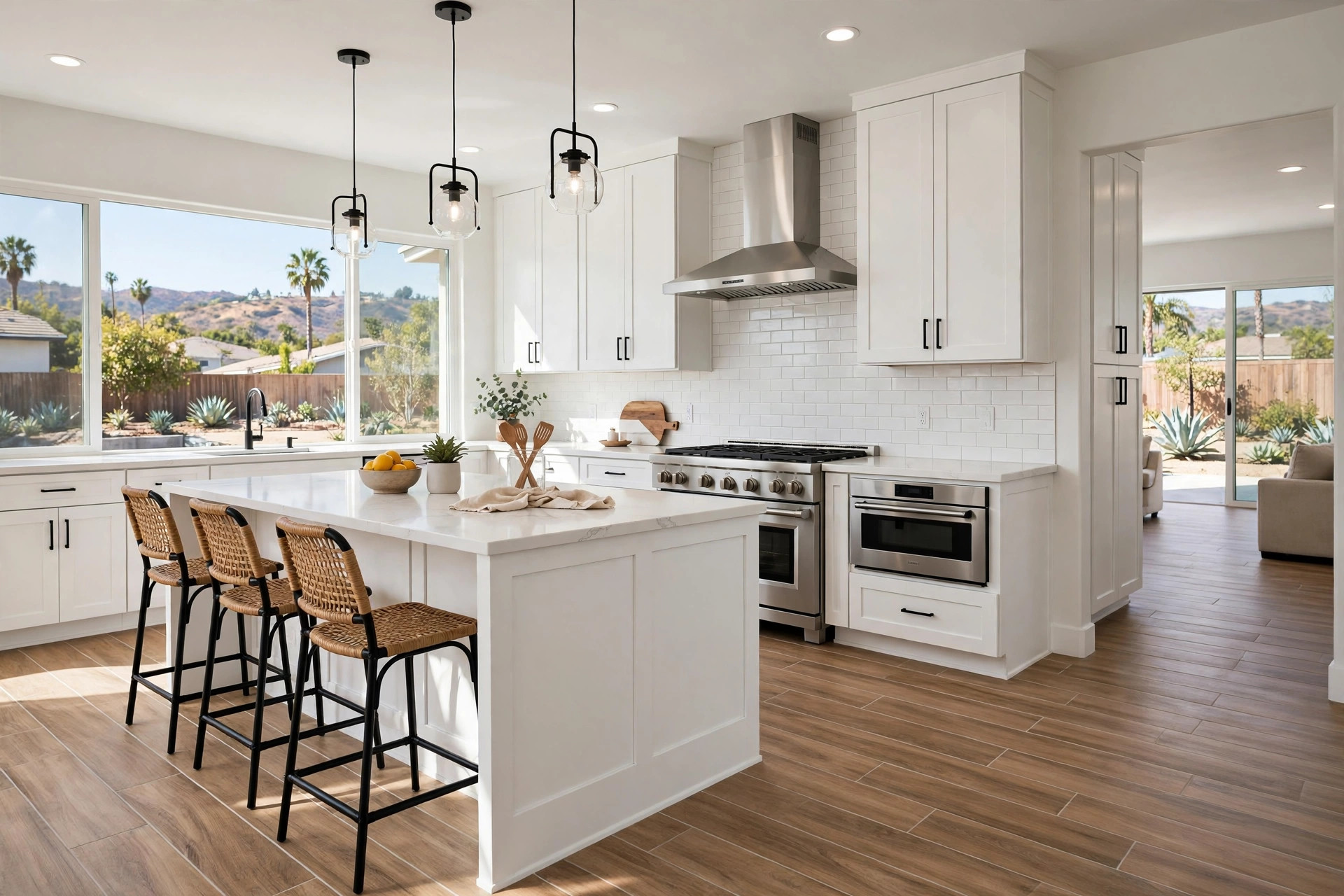
Tile is the default kitchen floor in many South Bay homes, and the reasons are practical. Porcelain tile barely absorbs water, it resists stains and scratches, and it comes in sizes and styles that suit almost any kitchen — including wood-look planks that mimic hardwood grain without the moisture risk.
Durability and Water Resistance
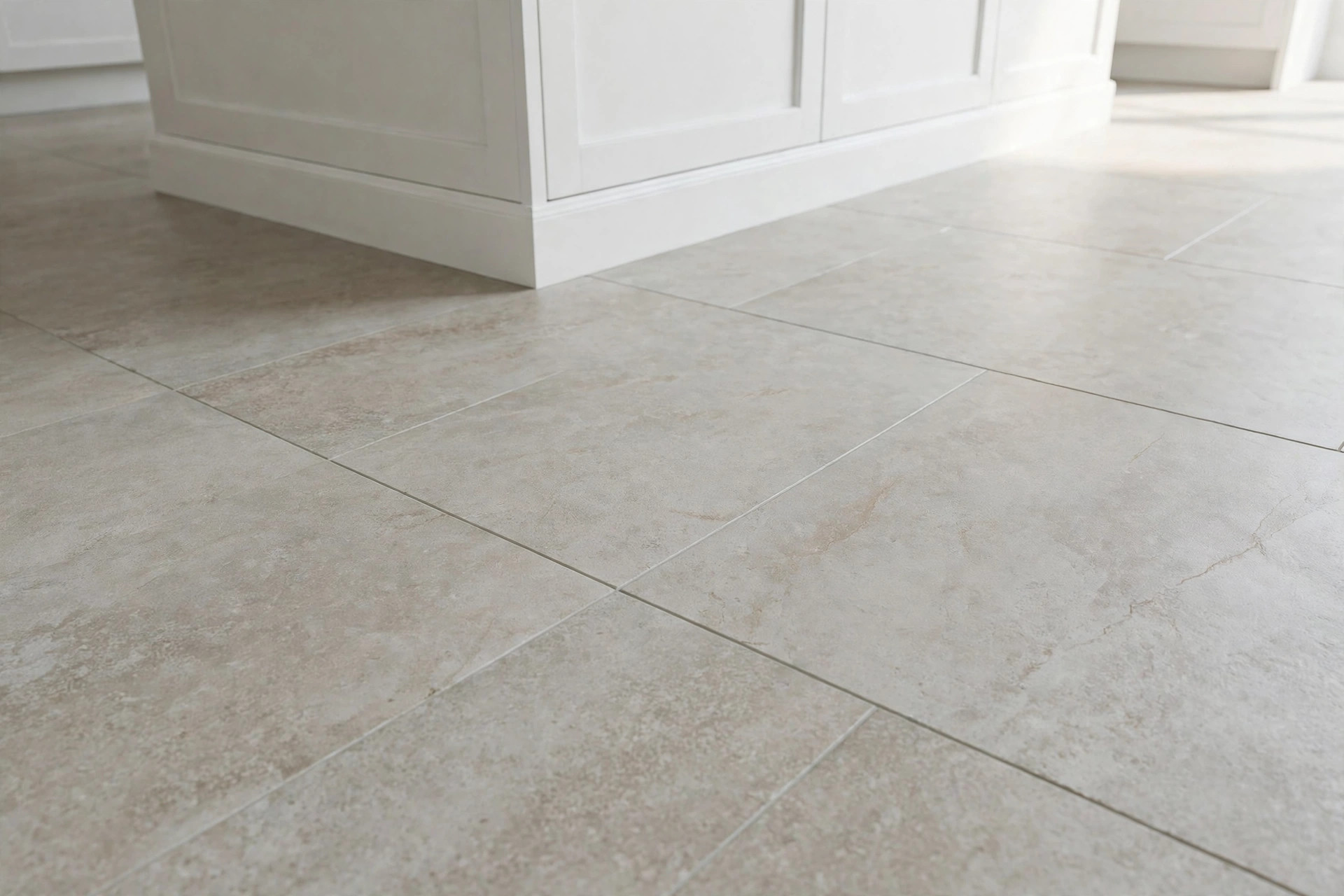
Porcelain is fired at a higher temperature than ceramic, which makes it denser and harder. A quality porcelain tile shrugs off dropped pans and dragged furniture. It does not swell, warp, or stain from standing water, which is why it is the standard choice around dishwashers and refrigerators with water lines. Ceramic tile is softer and more porous, so it suits walls and backsplashes better than a high-traffic kitchen floor.
Grout Lines and Cleaning
Grout is tile’s weak point. Standard cement grout absorbs spills and can stain, especially in light colors. Epoxy grout resists staining far better and is worth the extra cost in a kitchen. Large-format tiles, 24 inches and up, mean fewer grout lines to clean. A sealed grout line and a weekly mop keep a tile floor looking new for years.
Cost and Comfort
Tile sits in the middle of the price range for kitchen flooring, with porcelain generally costing more than ceramic. Installation costs more than floating floors because tile needs a level subfloor, thinset, and grout work. The trade-off is a floor that can last decades. Tile feels hard and cool underfoot, which suits Chula Vista’s warm summers, though a rug or mat at the sink makes long prep sessions more comfortable. In-floor heating is an option during a full remodel, and it changes the feel of tile completely in the cooler months.
Hardwood and Engineered Wood
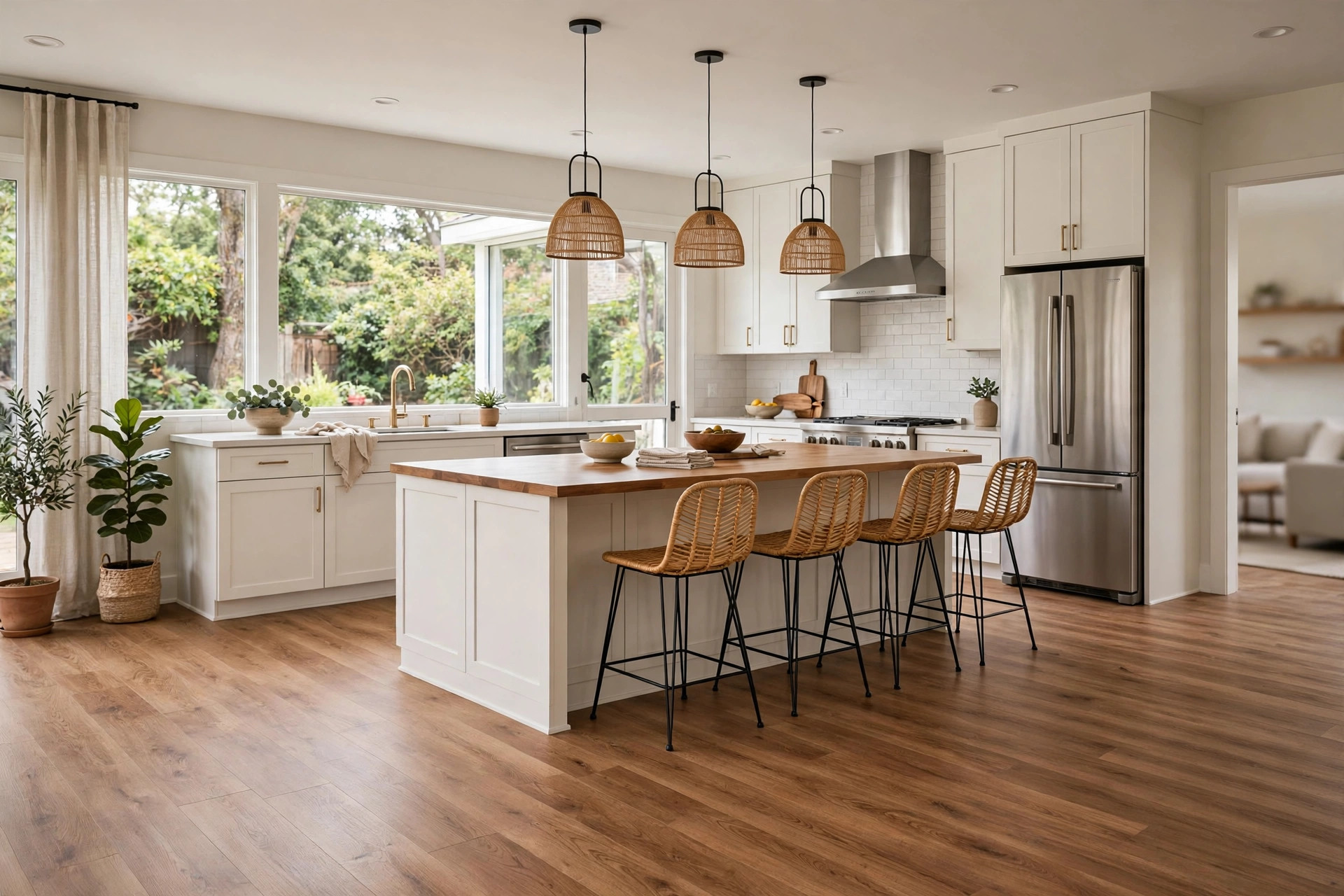
Solid hardwood brings warmth that no other kitchen floor matches. Engineered wood keeps most of that look with a construction that handles moisture better. Both have a place in kitchens, with one condition: water discipline.
Solid Hardwood in a Kitchen
Solid hardwood is a single piece of wood through its full thickness, which means it can be sanded and refinished several times over its life. It feels warm underfoot, it ages gracefully, and it ties a kitchen to wood floors in the rest of the house without a transition strip. The risk is water. A slow dishwasher leak or a spill left overnight can cup or stain solid planks. Site-finished hardwood with a strong polyurethane topcoat holds up better than prefinished boards, because the finish seals the seams between planks.
Engineered Wood
Engineered wood has a real hardwood veneer over layered plywood. That cross-layered core moves less with humidity changes, which makes it more stable in a kitchen than solid hardwood. It can be refinished once or twice depending on the veneer thickness. For Chula Vista homes, where coastal humidity shifts through the year, engineered wood is often the practical middle ground between solid hardwood and a fully waterproof floor.
Where Wood Works Best
Wood floors suit kitchens where spills get wiped up promptly and the dishwasher and refrigerator lines are checked regularly. Households with a dog that tracks in water from the yard, or a sink area that sees constant splashing, will spend more time maintaining wood. Wood pairs well with the warm wood kitchen ideas many South Bay homeowners favor, and it keeps a consistent look through an open-plan living space.
Luxury Vinyl Plank (LVP)
Luxury vinyl plank is the fastest-growing kitchen flooring choice, and the reason is simple: it looks like wood or stone, it handles water, and it costs less than both. Modern LVP has a rigid core that clicks together and floats over the subfloor, with a wear layer that resists scratches from pets and furniture.
Water Resistance and Durability
Most LVP sold today is fully waterproof at the plank level, which makes it one of the safest choices around sinks and dishwashers. The wear layer thickness matters more than the brand name — a 20-mil wear layer holds up far longer in a busy kitchen than a 12-mil one. Quality LVP resists dents from dropped items better than laminate and better than most hardwood.
Look and Feel
LVP has improved to the point where a good plank fools most people at a glance. Wood-look planks carry grain texture and varied tones; stone-look tiles carry the color variation of real slate or travertine. Up close, the repeating patterns and the softer feel underfoot give it away, but from standing height in a finished kitchen, the effect is convincing. LVP feels softer and quieter than tile, which matters in a kitchen where someone stands for an hour making dinner.
Cost and Installation
LVP is usually the most affordable of the waterproof options, and installation is faster than tile or hardwood because it floats over the existing subfloor. That speed matters during a remodel, since the floor can go in late in the project without a long cure time. One limit to know: LVP can show telegraphing from an uneven subfloor, so the subfloor still needs to be flat, even if it does not need to be perfect.
Laminate Flooring
Laminate is the budget option in this comparison, and it has improved well beyond the shiny, hollow-sounding floors of a decade ago. A quality laminate plank carries a photographic wood or stone image under a clear wear layer, and newer water-resistant versions handle kitchen spills far better than older ones.
What Laminate Does Well
Laminate costs less than hardwood, tile, or LVP, and it installs quickly as a floating floor. It resists scratches from chairs and pet claws, and the range of wood looks is wide. For a homeowner refreshing a kitchen on a tight budget, or for a rental property in the South Bay, laminate delivers a finished look without the price of the other materials.
The Water Limit
Standard laminate has a fiberboard core that swells when water gets into the seams, so a leak around the dishwasher or a spill left standing can damage it permanently. Water-resistant laminate, with sealed edges and a water-repellent core, handles everyday splashes but still should not sit in standing water. Laminate is a reasonable choice for a kitchen where the plumbing is new and the household is quick with a towel. It is a poor choice for a kitchen with a history of leaks.
Natural Stone
Natural stone — slate, travertine, marble, and granite tile — gives a kitchen a look nothing else can match. Each tile carries its own veining and color variation, so the floor reads as one of a kind. Stone is also the most demanding option in this list.
Durability and Maintenance
Stone is hard and long-lasting, but it is porous. Travertine and marble absorb spills, and acidic liquids like lemon juice or tomato sauce can etch the surface. Every stone floor needs sealing at installation and resealing on a regular schedule. Slate is the most forgiving of the common kitchen stones, with a naturally slip-resistant texture and a color range that hides dirt well. Marble is the least forgiving and suits kitchens where looks matter more than low maintenance.
Cost and Comfort
Stone is the most expensive option here, both for the material and for the installation, which needs a skilled setter and a strong subfloor. Like tile, stone feels hard and cool underfoot. It also adds weight, so the subfloor and joists need checking during a full remodel. For a homeowner who loves the look and accepts the upkeep, a stone floor can anchor a kitchen for decades.
Kitchen Flooring Compared Side by Side
| Flooring | Water resistance | Durability | Comfort | Relative cost |
|---|---|---|---|---|
| Porcelain tile | Excellent | Excellent | Hard, cool | Mid-range |
| Hardwood / engineered wood | Fair to good | Good | Warm, comfortable | Mid to high |
| Luxury vinyl plank | Excellent | Very good | Softer, quiet | Lower to mid |
| Laminate | Fair (water-resistant types: good) | Good | Moderate | Lowest |
| Natural stone | Good when sealed | Excellent | Hard, cool | Highest |
Cost varies with the product line, the size of the kitchen, and the condition of the subfloor. A small galley kitchen costs far less to floor than an open-plan kitchen that flows into the living room, and a subfloor that needs leveling adds to any of these options.
Choosing Flooring for a Chula Vista Home
Chula Vista kitchens have a few local factors worth weighing. Coastal humidity drifts through the year, so a floor that moves with moisture changes — solid hardwood, unsealed stone — needs more attention than a stable option like porcelain or LVP. Homes near the bay and in Imperial Beach see more salt air, which favors non-porous surfaces.
Open-plan layouts are common in South Bay remodels, and a single flooring material running from the kitchen into the living room makes the space feel larger. Wood-look tile and LVP both do this well, since they carry the warmth of wood without the water risk at the kitchen end. A sharp transition between kitchen tile and living room wood can chop an open plan into pieces.
Pets and children change the math too. A household with a large dog will value scratch resistance and easy cleanup over the warmth of real wood. A household that cooks most nights will value a floor that forgives a dropped pot and a splashed stockpot. The best flooring for a kitchen is the one that fits the household that uses it, not the one that photographs best.
Vexkitch Kitchen Remodeling has completed more than 700 kitchen projects across Chula Vista and the South Bay since 2017, and flooring is one of the decisions homeowners revisit most after move-in — usually because the floor they chose for looks turned out to be wrong for how the kitchen actually gets used.
Flooring Mistakes Worth Avoiding
- Choosing flooring for looks alone without checking how it handles water around the sink and dishwasher.
- Installing a new floor over an uneven subfloor — tile cracks, LVP telegraphs the bumps, and wood planks gap.
- Picking a grout color that shows every stain, instead of a mid-tone or epoxy grout in a working kitchen.
- Ordering flooring before the final cabinet layout is set — the square footage changes, and a short order delays the whole project.
- Skipping the transition plan where the kitchen floor meets the hallway or living room — a mismatched height or an awkward strip stands out every day.
- Forgetting a spare box of planks or tiles — a matching repair years later is simple when the material is on hand, and nearly impossible when the line is discontinued.
The kitchen backsplash and flooring services page covers how flooring and backsplash work fit into a full remodel, including installation timing and how the two surfaces meet at the wall.
Free Download
Kitchen Flooring Options Checklist — a one-page checklist from Vexkitch Kitchen Remodeling that walks through the flooring decisions covered above: water resistance, durability, comfort, cost, and what suits a Chula Vista home. Print it and bring it to the showroom.
Download the Kitchen Flooring Options Checklist (PDF)
Frequently Asked Questions
What is the best flooring for a kitchen?
Porcelain tile and luxury vinyl plank are the safest all-around choices because both handle water, resist scratches, and clean easily. Hardwood suits kitchens where spills are wiped up quickly. The best floor depends on the household — pets, children, and how often the kitchen is used matter as much as the material.
Is hardwood flooring good in a kitchen?
Hardwood works in a kitchen when spills are cleaned up promptly and plumbing is in good shape. Engineered wood handles humidity changes better than solid hardwood, which makes it the safer wood choice for Chula Vista homes. A slow leak is the main risk, so dishwasher and refrigerator lines deserve regular checks.
Does LVP hold up in a kitchen?
Yes, quality LVP with a 20-mil wear layer holds up well to daily kitchen use, including pets, dropped items, and standing water. It is one of the most forgiving kitchen floors for both wear and water, and it installs faster than tile or hardwood.
Is tile flooring cold underfoot?
Tile feels cool, which many Chula Vista homeowners appreciate in summer. A rug or mat at the sink and stove softens the feel during long cooking sessions. In-floor heating can be added during a full remodel and makes tile comfortable year-round.
Can you install new kitchen flooring over old flooring?
Sometimes. LVP and laminate can float over a flat, sound existing floor. Tile and hardwood usually need the old floor removed and the subfloor checked. A remodeler should inspect the subfloor before deciding, since a hidden problem under the old floor becomes a bigger repair later.
How much does kitchen flooring cost?
Cost depends on the material, the size of the kitchen, and the condition of the subfloor. Laminate and LVP sit at the lower end, porcelain tile in the middle, hardwood and engineered wood higher, and natural stone at the top. Installation, subfloor preparation, and trim add to the material price, so a quote for the whole job is more useful than a per-square-foot material price alone.
Planning Your Kitchen Remodeling Project?
Flooring is the surface a kitchen is used on every day, and it touches every other decision in a remodel — the cabinets, the countertops, the layout, and the way the room flows into the rest of the house. Getting it right takes a plan that covers the whole kitchen, not just one material.
Explore our complete kitchen remodeling services in Chula Vista to plan your project with a structured approach. Vexkitch Kitchen Remodeling has served Chula Vista and South Bay homeowners since 2017, with more than 700 completed projects.